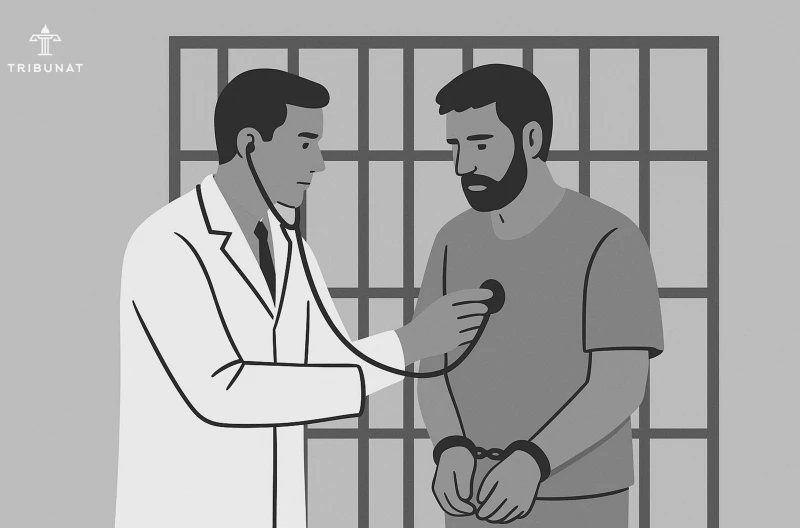
Political prisoner Nazim Baydamirli's health has reportedly deteriorated sharply in the prison where he is being detained. According to his wife, Baydamirli told her on the phone that he was short of breath and was choking. “Upon the call for help from fellow prisoners, the duty unit took him to the medical center. His body heat was 37.7 degrees Celcius. However, Nazim, seeing that the person who wanted to provide medical assistance was not a doctor, but a prisoner, refused intravenous treatment” Farida Baydamirli noted.
“Tribunat”, on the basis of the following incident, investigated whether the medical assistance provided to prisoners in penitentiary institutions meets healthcare standards.
Nazim Baydamirli was sentenced to 8 years of deprivation of liberty by the Baku Grave Crimes Court on September 30, 2025. He is currently serving his sentence in penitentiary facility No. 13, located in the capital.
Article 41 of the Constitution recognizes the right of everyone to protect their health and receive medical care. The article stipulates the obligation of the State to protect everyone's health and ensure access to medical care. This norm covers both preventive measures (disease prevention) and medical assistance (specialized medical care, emergency care, and the like). The norm imposes on the State the obligation to properly organize the healthcare infrastructure and staffing in order to ensure the right of citizens to health.
According to Article 3 of the “Regulations on the Penitentiary Service of the Ministry of Justice of the Republic of Azerbaijan”, the duty of the penitentiary service is to take measures to ensure that detainees and prisoners comply with general and personal sanitary and hygiene requirements, to protect the health of detainees and prisoners, and to create the necessary conditions for the implementation of medical and sanitary provision. This provision implies not only ensuring the conditions of detention in penitentiary institutions but also ensuring that prisoners behave in accordance with personal hygiene and sanitary requirements. The penitentiary service must provide sufficient equipment for the implementation of this duty and maintain the necessary number of doctors and sanitary personnel. Failure to provide these duties may pose risks to the health of prisoners.
In accordance with the 2024 report of the Commissioner for Human Rights, arrested and prisoners should have access to medical services at any time, regardless of the detention regime, and requests for medical examination should be organized without unnecessary delays. Even though the report does not provide detailed information on the state of medical provision, it is noted that in order to eliminate the negative effects of the problem of overcrowding on access to medical services, especially given the vast number of detainees in pre-trial detention centers, it is necessary to adjust both medical staff and medicines and other medical supplies to the actual number of detainees, not to the presumed limit of the institution.
According to the European Prison Rules (Rule 41), one of the basic requirements for prisons is that a medical assistant should be appointed in every prison to ensure that prisoners can receive medical care when they need it. The medical assistant should be a qualified doctor. In sizable prisons, a sufficient number of doctors should be appointed on a full-time basis. In general, at least one doctor should be available at all times to deal with urgent medical matters.
Problems with medical services in Azerbaijani penitentiary institutions are well-spread. The lack of examination equipment in the Penitentiary Service's Treatment Facility, the selection of prisoners transferred to treatment facilities mainly from among those with high financial means, Nazim Baydamirli being offered an intravenous injection by a prisoner rather than a medical worker and the similar instance suffice to say that there are serious problems with medical services in penitentiary institutions.
Another grave problem is the lack of accurate information in open sources on the number of medical personnel in penitentiary institutions. This aggravates the assessment of the quality and accessibility of services and prevents determining the adequacy of resources.
The European Committee for the Prevention of Torture and Inhuman or Degrading Treatment or Punishment (CPT) noted ongoing problems with medical services in penitentiary institutions in Azerbaijan during its 2022 ad hoc visit. The Committee noted that medical personnel need training, examinations are often superficial, the range of medical services provided is limited, and there is a lack of both specialists and equipment for first aid.
The medical care offered to Nazim Baydamirli could have posed a threat to his health. All in all, this could be considered a violation of Article 3 (prohibition of torture) of the European Convention on Human Rights (Convention). In the following cases, the European Court of Human Rights has recognized the restriction of the right to medical care as a violation of the Convention:
In Yunusova and Yunusov v. Azerbaijan, the Court recognized the failure to ensure the applicant's right to medical care as a violation of Article 3 of the Convention.
In Eldar Hasanov v. Azerbaijan, the Court noted that while Article 3 does not impose a general obligation on the Government to release a prisoner on health grounds, the medical care provided in prisons must be in line with the level that the Government undertakes to provide to the population.
In Hummatov v. Azerbaijan, the Court found that the lack of adequate medical care in Gobustan Prison was a violation of Article 3, as it caused the prisoner to suffer mental anguish and diminished his human dignity.
The funds from the state budget for healthcare programs in the Penitentiary Service of the Ministry of Justice in the amount of 12,747,459 (twelve million seven hundred forty-seven thousand four hundred fifty-nine) manats in 2024, 14,949,049 (fourteen million nine hundred forty-nine thousand forty-nine) manats in 2023, 12,456,273 (twelve million four hundred fifty-six thousand two hundred seventy-three) manats in 2022, and 12,115,519 (twelve million one hundred fifteen thousand five hundred nineteen) manats in 2021 were allocated by the relevant decrees of the President.
Even though financial resources are allocated from the state budget for the Penitentiary Service's health programs every year, reports on the spending of these funds are not posted on the Ministry of Justice's website. It is unknown how the funds are actually spent. The lack of transparency and accountability makes it impossible to control the expenditure of these funds.
“Tribunat” concludes that the unprofessional medical care offered to Nazim Baydamirli is a violation of his rights to receive medical care and the prohibition of torture.