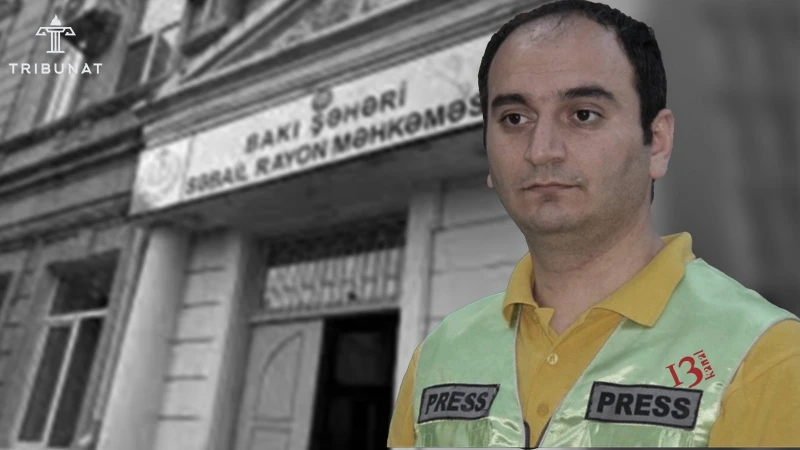
During the trial of the director of the internet television channel “Kanal 13”, Aziz Orujov, held in the Sabail District Court, his lawyer submitted a motion to allow media representatives to attend and record the trial. Presiding judge Gunel Samadova did not satisfy the motion, stating the lack of necessity for journalists to participate in the trial, and that they could receive information about the trial from the court's press service.
"Tribunat" analyzed the legality of the court's decision to exclude media representatives from Orujov's hearing with the principle of public trial.
According to the requirements of the Constitution of the Republic of Azerbaijan (Article 127, Clause V) and the European Convention on Human Rights, ECHR (Article 6), to which the State is a party, proceedings in all courts should be public.
Public trial entails that court hearings should be held in accordance with legal procedure and generally in the presence of the people. Unless there is a specific requirement for confidentiality, anyone—journalists, citizens, organizations, and others—may observe the proceedings. It is intended that the trial is transparent and decisions are made under public supervision. Public trials assist to ensure the precision and legality of court decisions, and simultaneously create conditions for the legal reliance in society.
Only exception to this rule causes the exclusion of the press and the public from the hearing of the case for all or part of the proceedings when, in a democratic society, reasons of morality, public order or national security so require, as well as when the interests of minors or the protection of the private life of the parties so require, or when, in the opinion of the court, publicity would prejudice the interests of justice in special circumstances where it is strictly necessary.
The grounds for holding a closed trial provided for in the Convention are more clearly listed in the relevant provisions of the Codes of Criminal Procedure, Civil Procedure, Administrative Procedure and Administrative Offenses. Other than these grounds, close trial is not provided for.
The use of technical means in public trials, including photography, audio and video recording, and live broadcasting of the proceedings, may be carried out with the permission of the presiding judge. However, this authority is granted to the courts not to limit the publicity of the proceedings, but to protect the rights of the parties, and the court must refer to the abovementioned cases to limit the recording of the proceedings.
Article 188.2 of the Criminal Code, which A. Orujov is accused of, penalizes the conduct of unauthorized construction or installation on property without the right to ownership, use or lease. This article is mainly related to the violation of property rights and belongs to the category of less serious crimes due to the degree of public danger. Since there is neither state secrets nor sensitive information related to private life, there is no legal basis for closed trial.
In the case of Axel Springer AG v. Germany (§ 80), the Court noted that the principle of public trial also extends to the coverage of proceedings by the press and journalists and their expression of opinions. If these activities do not exceed certain limits (i.e. do not impede a fair trial and do not damage the reputation of the court), the principle of public trial is applicable. This also satisfies the requirement of Article 6 § 1 of the ECHR that “court proceedings shall be public”. Simultaneously, it is inconceivable in a democratic society that there should not be public discussion of the proceedings before or at the same time.
Bearing in mind that Aziz Orujov is a political prisoner and was allegedly arrested for his journalism, events at his trial are a matter of public interest. Therefore, the demand for a public discussion of court hearings is natural and necessary. This also serves the public's right to receive this information.
The ECtHR in the case of Dadashbeyli v. Azerbaijan does not consider the presence of confidential information in the criminal case materials as a basis for a closed trial. Expressing its opinion on the position of the domestic courts in this regard, the Court noted that the presence of confidential information in the case materials does not provide a basis for a closed trial as a whole. The courts must draw specific conclusions on the necessity of exclusion to protect the interests of the state and limit confidentiality to the extent necessary to protect such an interest.
“Tribunat” concludes that public trial necessitates openness both physically and in terms of information. Restricting the ability of journalists to cover the proceedings deteriorates public control, which can damage public trust in the judiciary. The Sabail District Court's ban on the participation of media representatives in Aziz Azizov's trial should be considered a violation of the principle of public trial, due to the absence of specific legal and factual grounds.