Three Arab tourists have been detained for allegedly filming an offensive video in the Alley of Martyrs. According to domestic media, on August 18, the Sabail District Court sentenced them to three months in pre-trial detention. The video circulating on social networks shows the tourists laughing and performing various actions while looking at the graves in the Alley of Martyrs. The publication of the video caused criticism in the Azerbaijani segment of social networks. It is reported that the tourists have been brought to criminal liability under the article of the Criminal Code of the Republic of Azerbaijan (CC) for grave desecration.
“Tribunat” has investigated the issue and analyzed the actions performed in the video from the point of view of criminal legislation.
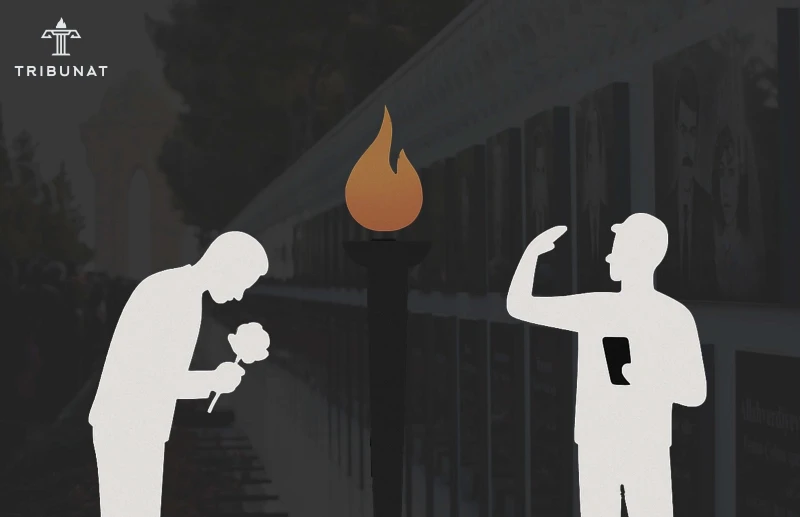
The video describes one of the foreigners jumping, showing a photo of a martyr on his phone, looking at the grave and speaking in Arabic, laughing and walking in a dubious way, giving a military salute and laughing again. One of the other two tourists is filming, but the other’s actions are not visible in the video.
According to Article 14 of the CC, Crime shall be admitted as a socially dangerous action (action or inaction), forbidden by the present Code, under threat of punishment on guilt. That is, for the committed act to be considered a crime, that act must be prohibited and deliberately specified in the Code.
The Decision of the Plenum of the Constitutional Court dated March 17, 2011 on the interpretation of Article 244.1 of the CC states that the interpretation of a crime is a legal assessment of a wrongdoing that is reflected in the relevant procedural document and results in penal-legal consequences by determination of the correspondence between the features of a specific criminal act committed and the constituent elements provided for in the disposition of the norm. The interpretation of a crime has significant social and legal significance. The interpretation is an important logical process carried out by officials authorized to apply criminal law in terms of fulfilling the duties specified in the Criminal Code, as a result of which a legal assessment is given to a specific social event, human behavior being socially dangerous. Initially, a comprehensive study of the factual circumstances of the case, the selection of a criminal law norm and an explanation of its content is required. The Plenum puts forward that while investigation of each criminal act, the correct determination and description of its composition is aimed at determining whether the acts reflecting the signs of a crime are crimes or not, whether the person accused of committing a crime is guilty or not, as well as determining a fair punishment for the person accused of that crime. Otherwise, it may lead to an innocent person to be accountable, or the person guilty of committing a crime to be exempt from responsibility, and the incorrect application of punishment. This, in turn, may lead to a violation of the principles of legality, equality before the law, liability for guilt, justice and humanism on which the CC is based.
Another Decision of the Plenum of the Constitutional Court dated May 20, 2011, on the interpretation of Article 221.3 of the CC, emphasizes that the incorrect determination and interpretation of the elements of a criminal act can lead to a violation of an individual’s right to liberty.
Article 245 of the CC is labelled as an offensive action on a grave or corpse. The Code does not clarify the content and scope of “offensive” actions. The norm has no official interpretation and is open to subjective annotation.
The Commentary on the Criminal Code of the Republic of Azerbaijan, edited by Doctor of Laws, Professor Firudin Samandarov, states that “offensive action on a grave is understood to imply committing immoral, shameful acts that grossly violate the generally accepted rules of burial of a corpse, the customs and traditions existing in this area, such as destroying, damaging and spoiling graves, writing immoral words and expressions on gravestones, drawing pictures, signs and the like”. Such acts include digging up a grave, removing a corpse, illegally removing organs and tissues of a corpse, dismembering a corpse into separate parts or drawing various signs on its skin, and so forth.
Grave desecration is an act that is considered a criminal offense, regardless of the emotional impact on the deceased's loved ones and society. Grave desecration is contemplated as a criminal act even not recorded on video and shared publicly.
Similar offenses are more specifically regulated in the criminal legislation of a number of countries neighboring Azerbaijan and once sharing the same legal space. For instance, Article 297 of the Criminal Code of Ukraine (“Vandalizing a grave”) defines desecration of a grave as the destruction of a grave or any other burial place, a corpse or a coffin, as well as the theft of items from a grave or corpse.
Article 258 of the Criminal Code of Georgia ("Disrespect to the deceased") considers it a criminal offense to desecrate a corpse or grave, damage a tombstone or other grave-site installations, and illegally remove an object from or on a grave.
Article 153 of the Turkish Criminal Code (Penal Law) ("Damage to places of worship and cemeteries") considers it a criminal offense to damage places of worship, their additional structures, the objects therein, graves, the structures on, and the objects in the cemetery and those built for the purpose of protecting the cemetery.
The analysis of anonymized verdicts regarding Article 245 of the CC in the “Electronic court” information system gives grounds to say that when courts refer to offensive acts, they consider destroying a grave and the items on it and inappropriate inscriptions on a grave as offensive acts on a grave. For instance, in the Decision No. 1(008)-849/2023 of the Sabunchi District Court of Baku dated 24.11.2023, the accused’s rupture of several gravestones was interpreted as Article 245 of the CC, and the defendant was found guilty of committing a criminal act provided for in Article 245 of the CC and was sentenced to 8 (eight) months of imprisonment. In another Decision of the same court, No. 1(008)-119/2021, dated 28.04.2021, the defendant's anger and writing inappropriate statements on the grave with a red marker were considered offensive acts on the grave, and the accused was again found guilty of committing a criminal offense under Article 245 and sentenced to 9 (nine) months of imprisonment. In the Decision of the Bilasuvar District Court, No. 1(022)-45/2023, dated 15.03.2023, the accused, who was found guilty under Article 245 of the Criminal Code, first kicked over the flower pots on the grave and then left because there were other people around, but returned in the evening and broke the gravestone. The accused was found guilty under Article 245 of the Criminal Code and sentenced to 2 (two) years of imprisonment under the same Article.
Hence, both the Commentary of the Criminal Code of Azerbaijan and the cited judicial practice give grounds to conclude that the actions of tourists cannot be considered offensive actions. Having fun in the cemetery, laughing, walking in a strange way cannot be considered “offensive actions over a grave or a corpse”. The opposite would excessively expand the scope of offensive actions envisaged in the norm, which could result in an uncertain legal situation.
On the other hand, the place where the crime was committed must be a grave. The alleged offense was committed not on a specific grave, but in the cemetery (Alley of Martyrs’).
In addition, Article 245 of the CC is an offense committed with direct intent. Even if the official is considered to be theoretically correct, Arab tourists do not intentionally commit actions that are interpreted as offensive actions on graves, that is, they do not have the desire to insult the graves, at least the opposite is not visible from the video footage.
Furthermore, offensive action always involves the intention to indecently degrade the honor and dignity of another individual (in this case, the grave) (the motive for the crime in this context). Nonetheless, it is impossible to observe such an intention here.
Likewise, since the alleged illegal acts of the Arab tourists were committed in the Alley of Martyrs, the act cannot be described under Article 245 of the CC. The Alley of Martyrs is considered a culturo-historical monument. According to the Law “On the Protection of Historical and Cultural Monuments”, historical monuments include values related to the history of society and the state, the war and the national liberation movement, the development of science and technology, and important historical events in the life of the society, buildings, houses, memorial sites, documents and objects related to the lives of statesmen and military figures, Heroes of the Patriotic War of the Republic of Azerbaijan, National Heroes of Azerbaijan, Heroes of the Soviet Union, and prominent figures of science and art, ethnographic monuments - buildings and tools of labor, objects, documents and objects reflecting the material, spiritual, ideological, artisanal and economic life of the people, epigraphic monuments - various stone, clay, wood and metal samples with inscriptions (§2c). According to the Decision No. 132 of the Cabinet of Ministers dated August 2, 2001 “On approval of the classification of immovable historical and cultural monuments under state protection in the territory of the Republic of Azerbaijan in accordance with their importance”, the Alley of Martyrs is included in the list of historical and cultural monuments.
The annotation to Article 245 of the CC puts forward that if the offensive acts were committed on a grave that is considered an object of historical and cultural significance by law, the act should be classified under Article 246 of the CC.
The concepts of “destruction” and “damage” stipulated in the disposition of Article 246, entitled “Deliberate destruction or damage of historical and cultural monuments”, are explained in the unofficial Commentary of the Criminal Code as follows: “Destruction means rendering the mentioned objects in a state of complete unserviceability by means of demolition, burning, explosion or other mechanical action, which permanently loses value and makes infeasible to use them for their intended purpose. Protection means rendering the objects mentioned protected by the state in a state of partial loss of their integrity or other properties, making it impossible to use them for their intended purpose without restoration. The degree of damage to the objects mentioned should be obvious even to non-specialists. Writing indelible inscriptions, drawing or painting on historical and cultural monuments and the like are not considered damage within the meaning of Article 246 of the CC.
According to the video footage of the accused Arab tourists circulating on social media, they do not interact with any objects in the Alley of Martyrs. It implies that the actions of these individuals do not contain the elements of Article 246 of the CC. Accordingly, the actions of the detained tourists do not include the destruction or desecration of graves in the Alley of Martyrs, which are considered historical and cultural monuments and protected by the state.
"Tribunat" concludes that the actions of the Arab tourists in the Alley of Martyrs do not constitute a criminal offense. These individuals cannot be found guilty under Article 245 of the CC, and the imposition of a pre-trial detention measure on them should be considered a violation of the tourists' right to liberty.