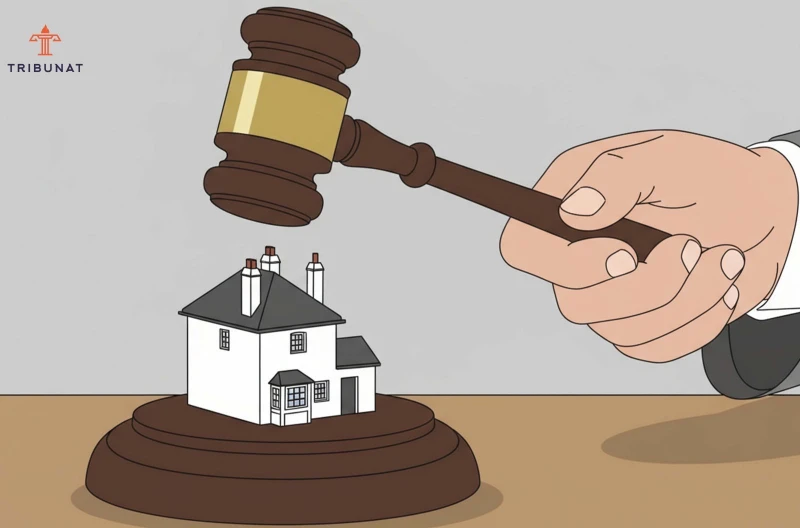
Lala Sultanova, a resident of Gadabay district, claims that the head of the district's executive authority, Orkhan Mursalov, illegally demolished her houses. In videos circulating on social networks showing the destroyed houses, the citizen states that these buildings belonged to her family and were demolished using heavy equipment without any official warning. In her words, the land on which the houses are located was her personal property and the deed was based on official documents. She indicates that neither the local executive authority nor any other state body sent her any official notification or warning. They simply brought in equipment and demolished her house.
“Tribunat” has investigated this issue from the perspective of interference to the right to property.
Legislation on right to property and authorities of executive bodies in Azerbaijan
The demolition of houses built by citizens on land owned by them under their ownership rights is illegal, and there is no legal basis for interference with property rights. In accordance with the Constitution and Civil Code of the Republic of Azerbaijan, property rights are inviolable.
By Article 29 of the Constitution, everyone enjoys the right to property, no one may be deprived of their property without a court decision, and everyone may own movable and immovable property. The right to property consists of the owner's rights to own, use and dispose of property alone or together with others. No one may be deprived of their property without a court decision. Complete confiscation of property is not allowed. Alienation of property for public interest is allowed only on condition of prior fair payment of its value.
According to Article 152 of the Civil Code, the right of ownership is the right of an individual to own, use and dispose of property, recognized and protected by the state. Via Code, the owner has the right to demand the recognition of his right, the elimination of illegal possession and the cessation of interference with property. This establishes the owner's right to own, use and dispose of property and excludes illegal interference by state authorities. No executive body or official may encroach on the property of a citizen without a court decision. Interference is possible only in the general interest, in cases provided for by law and with the provision of fair compensation.
If a building is illegally constructed or is in violation of urban planning regulations, this cannot constitute grounds for automatic restriction of ownership rights. The territory may be acquired by the state only if it is required for public interest, provided that fair compensation is paid.
In the present case, a citizen has installed A-frame houses and a gazebo on his private property. These facilities neither serve the public interest nor pose a threat. Despite this, the houses were demolished by the executive authority, even though no court order was submitted for this step, nor was an official notification sent to the owner. No public interest was substantiated.
In accordance with the Urban Planning and Construction Code, a permit is generally not required for the construction of single-floor auxiliary buildings with an area of 100 square meters and a height of 5 meters. A separate permit is not required for the construction of individual residential houses and certain auxiliary buildings with an above-ground number of floors of no more than 3 and a height of no more than 12 meters on land owned, leased or used by a citizen; in such cases, notification to the local executive authority is adequate. A citizen simply informs the local executive authority about the construction, submits the main plan of the project, documents confirming the ownership right, and upon no objections within 10 days, construction can legally be initiated. The Ministry of Emergency Situations exercises control over the construction of facilities subject to the notification procedure in accordance with the architectural-planning sections of the project and the master plan of the construction area. Even if these facilities were built for entrepreneurial or touristic purposes, their demolition and destruction without relevant court decision is inadmissible. Such interference is considered a violation of property rights. If a non-residential A-frame house on private property has been constructed, according to the Presidential Decree on non-residential buildings constructed before June 1, 2023, this facility should not be demolished as an illegal building, but rather should be legalized by going through the stages of technical inspection, registration, and operation permit.
On the other hand, the concept of “public interest” is understood as the acquisition of land for state needs. In accordance with the Law “On acquisition of land for public interest”, land can be acquired by the state only in cases specified in this law, and in this case, fair compensation must be paid. According to Article 3 of the Law, such cases include the construction and installation of roads of public interest and other communication lines, main oil and gas pipelines, sewage, high-voltage power lines and hydrotechnical facilities, ensuring reliable protection of the state border in the border strip, construction of objects of defense and security importance, mining and mining industry facilities of public importance, and increasing the area of the seaport. This process can be implemented only with a decision of the Cabinet of Ministers and approval by court.
The main function of district (city) executive authorities is to implement local governance, state policy at the local level, and ensure administrative control. District (city) executive authorities perform only administrative and supervisory functions in matters of property and construction; they do not have the authority to demolish buildings or interfere with property rights. Executive authorities perform the functions of supervising the repair and construction of state facilities, approving construction projects and issuing construction permits, and, if necessary, raising issues regarding construction with the relevant body.
By Urban Planning and Construction Code, district executive authorities carry out construction control and notification procedure, which is of the nature of administrative control. District executive authorities can draw up an act on illegal and dangerous buildings and lodge a claim to the court. Nonetheless, they do not enjoy the authority to carry out demolition on their own. The demolition of buildings is ensured only by the Executive Service of the Ministry of Justice of the Republic of Azerbaijan and the executive departments operating within, based on a court decision. No house, facility or structure can be demolished without a court decision.
State control over construction is carried out by the Main State Construction Inspectorate of the State Agency for Construction Safety Control of the Ministry of Emergency Situations. The main task of the Ministry of Emergency Situations is to monitor compliance with safety regulations, technical standards and urban planning legislation during construction and demolition processes. The Ministry of Emergency Situations may carry out demolition only in cases of real and immediate danger to human life, for instance, in the case of a risk of a building collapse, an explosion or a fire, in order to ensure the safety of people.
ECtHR decisions
According to Article 1 of Protocol No. 1 to the European Convention on Human Rights, every natural or legal person has the right to peaceful enjoyment of his possessions. No one shall be deprived of own possessions except in the public interest and in accordance with the law and the general principles of international law.
According to the case law of the European Court of Human Rights (ECtHR), the obligation to respect the right to property is not limited to the State's refraining from interference. The State must take positive measures to ensure the real and effective realization of this right. Accordingly, it must not only refrain from direct interference with a citizen's property, but must also take effective measures, through legislative, administrative and judicial mechanisms, to protect property against unlawful acts by third parties or public authorities.
The ECtHR found in Khalikova v. Azerbaijan that the process of “taking over” the applicant’s property for “public interest” was not carried out in accordance with the conditions prescribed by law. The applicant’s house was demolished by order of the Baku City Executive Authority, without a formal decision being taken by the competent state body, the Cabinet of Ministers. The Court concluded that the Baku City Executive Authority did not have the power to expropriate private property, no legal decision was taken by the competent state body, and as a result, the interference with the applicant’s property amounted to de facto expropriation. The ECtHR also noted that the sale contract concluded between the applicant and the representative of the executive power after the demolition of the property did not provide a legal basis for the situation and did not legitimize the interference.
Bagirova and Others v. Azerbaijan is also one of the most important precedents regarding illegal demolitions carried out by the executive authorities in Azerbaijan. The case examined the violation of property rights by demolishing houses in Baku’s Yasamal district under the guise of road and development works, without an official decision. The Court found that the procedures provided for in Azerbaijani legislation had been violated, the Cabinet of Ministers had only adopted a decision for the preparatory stage, but no main decision had been made on the acquisition of land and houses for public interest, and as a result, the demolition was considered illegal.
The ECtHR provides for that any demolition or confiscation of property can only be based on the principles of legality, public interest and a fair balance; if any of these requirements is violated, the interference is considered unlawful.
Violation of right to property – practice in Azerbaijan
In recent years, Azerbaijan has witnessed numerous cases of property rights violations. These cases are predominant not only in Baku, but also in various regions of the country. Illegal demolitions, evictions without compensation, and administrative interventions outside of judicial control interfere with citizens' property rights.
Since 2008, numerous houses have been demolished in Baku’s central parts under the guise of “urban improvement”, “construction for public interest”, and “infrastructure projects”.
Human Rights Watch’s 2012 report “They Took Everything from Me: Forced Evictions, Unlawful Expropriations, and House Demolitions in Azerbaijan’s Capital” illustrates that since 2008, as part of “urban improvement” and “infrastructure development” projects in Baku, state authorities have demolished hundreds of citizens’ homes and facilities without a court order, warning, or compensation. In some cases, houseowners were given neither written nor verbal notice, and demolitions were even carried out at night. While residents were in their homes, the roofs, doors, windows, stairs, and load-bearing walls of buildings were destroyed, posing a direct threat to human life. At least 24 such incidents have been documented, and in all of these cases, the demolition process was carried out using the method of “internal decomposition” – implying, the interior of the building was first destroyed.
The report also notes that the compensation offered did not correspond to fair market value, in many cases the right to access legal protection was not ensured, state authorities did not attend court hearings, demolitions were carried out without a decision being made, and citizens' complaints were held up for months.
Additionally, as a continuation of these projects, dozens of families were evicted from their homes as part of the “Winter Park” project. Hundreds of residents in the area were forcibly evicted from their homes without warning, sometimes at night, and in some cases, houses were demolished with the residents’ belongings inside. Compensation were set many times lower than fair market values, and in many cases, demolitions were carried out without a formal court order. Most of them later appealed to the European Court of Human Rights, which ultimately found that their rights had been violated.
Salamova and Others v. Azerbaijan, adopted in 2025, is one of the most recent ECtHR decisions confirming the unlawful nature of the forced evictions and demolitions in the Winter Park area. In this case, the ECtHR, having ruled on the same facts, found a violation of Article 1 of Protocol No. 1 to the Convention and ordered the restoration of the applicants’ right to just satisfaction. This reaffirmed the unlawfulness and injustice of the forced evictions and demolitions.
In general, the European Court of Human Rights has adopted a total of 73 decisions on the basis of Article 1 of Protocol No. 1 (right to property) regarding Azerbaijan from 2011 to October 2025, and recognized a violation of the right to property in 63 decisions.
In recent times, interference on property rights in Azerbaijan have become even more widespread. Currently, similar incidents are taking place in the Baku’s “Bayirshahar” area. In May 2025, the Baku City Executive Authotity announced that buildings considered “old and unusable” would be demolished as part of a new master plan, and eviction notices were sent to residents living in those areas.
These instances are carried out not only by state institutions, but also by private construction companies. In March 2024, the Melissa Group construction company demolished a house in Baku’s Yasamal district while residents were inside. Following footage of the incident on social media, the excavator driver, foreman, and company director were detained, and a criminal proceedings was initiated against the head of the Melissa Group company, Galib Mammadov, and his employees in connection with the demolition.
In addition to the current incident, there has been an increase in cases of demolition of houses built within the framework of entrepreneurship and rural tourism projects in the regions due to the intervention of executive authorities. In these cases, often the relevant court decision is not presented, official notifications are not sent, and compensation for damages is not provided to citizens.
The above facts demonstrate that the balance of interference with property rights is often violated, and illegal and uncompensated demolitions are systematic. The task of state authorities is not only to make administrative decisions, but also to ensure the rights of citizens. Violation of property rights is not limited to the loss of home and place of residence, it also directly affects the inviolability of private life, human dignity and security.