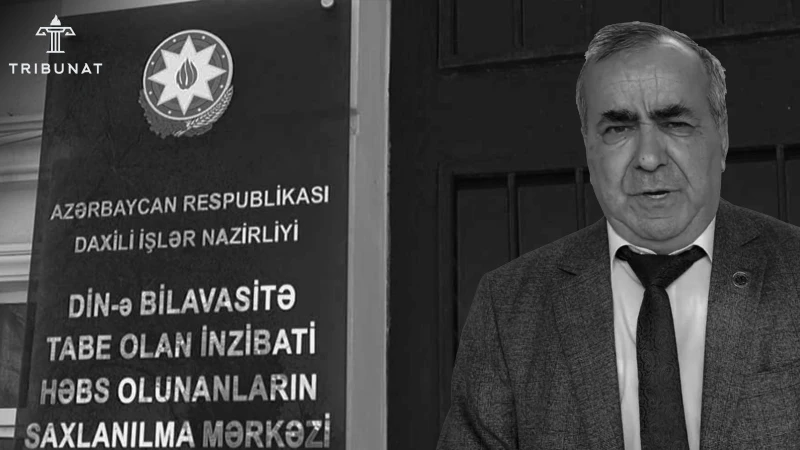
Advocate Nazim Musayev shared that his right to confidential communication with his client under administrative detention has been violated. In a Facebook post, the advocate indicated that the police tried to listen to all conversations without leaving his client being held in the Detention Unit for Persons under Administrative Arrest, and following his protest, they moved him and his client to a room with a glass partition and a microphone.
“Tribunat” has investigated the legality of the issue.
In accordance with the Code of Administrative Offenses, an individual against whom proceedings are being conducted on an administrative offense has the right to use the legal assistance of a defense counsel (advocate) during the consideration of the case (Article 61).
All institutions, enterprises and organizations are obliged to assist advocates in the performance of their professional duties. Necessary conditions must be created for private meetings and consultations with an advocate , and confidentiality must be ensured to provide legal assistance to detained and arrested persons, (Law “On Advocates and Advocacy”, Article 7). Via Article 15 of the Law, advocates... enjoy the right to meet and speak with the individual they are defending or representing in private, without hindrance.
From the moment of detention, adequate conditions must be created for an individual to meet with own advocate alone and to maintain confidential communication, without limiting the number and duration of meetings (Internal Disciplinary Rules of Temporary Detention Places, paragraph 6.1). Listening to their conversations during meetings is prohibited (paragraph 6.5).
At the Detention Unit for Persons under Administrative Arrest of the Ministry of Internal Affairs, advocate Nazim Musayev's intention to meet with his client alone and without hindrance was prevented, and contrary to the requirements of the listed norms, the institution prevented him from fulfilling professional duties.
The reports of the Ombudsman's Office on the activities of the National Preventive Mechanism against Torture have repeatedly indicated violations of the right to confidentiality between an advocate and client. These violations include the provision of a glass-walled room for meetings in prisons and conversations by telephone (2011 report, page 42), the monitoring of correspondence between prisoners and their advocates and the censorship of this correspondence (2014 report, pages 68-69, 2016 report, page 65, 2017 report, page 70), and the installation of cameras in the room designated for meetings (2020 report, pages 19, 35-36).
The recommendatory European Prison Rules state that the rights of detainees must be respected when they are treated, and that any restrictions imposed must be proportionate to the main purpose of their application and kept to a minimum (paragraphs 1 and 3).
The client of advocate Nazim Musayev, who was sentenced to administrative detention, is found guilty of committing an act of lesser public danger than a criminal act. None of the grounds for the control of visits in the European Penitentiary Rules (continuing criminal prosecution, maintaining public order and security, preventing crimes and protecting victims of crime) are applicable to this case.
The Constitution of the Republic of Azerbaijan (Article 32) and the European Convention on Human Rights (Article 8) puts forward that everyone shall not be interfered with in his private and family life. In accordance with the Convention, this right may be restricted in a number of cases (in the interests of national security, public order or the economic well-being of the country, for the prevention of disorder or crime, for the protection of health or morals, or for the protection of the rights and freedoms of others, which are prescribed by law and are necessary in a democratic society).
The Guide on Article 8 of ECHR promulgates that anyone wishing to consult an advocate should do so in circumstances which allow for a full and unhindered discussion. Lawyer-client privilege, oral communications and correspondence are in principle considered privileged under Article 8 of the Convention (paragraphs 269 and 271).
In Altay v. Turkey (no. 2), the Court held that communication with an advocate within the framework of legal aid fell within “private life” (§49).
In Campbell v. the United Kingdom, the European Court of Human Rights stated that the right to confidential communication with a lawyer may be subject to certain restrictions. However, the restrictions must be foreseeable for the persons concerned and “necessary in a democratic society”, that is, proportionate to the stated aims. Such restrictions may only be imposed in exceptional circumstances, such as the prevention of crime or the prevention of serious breaches of security or discipline in prison (§52).
Violation of the right to confidentiality between an advocate and a client is widespread in Azerbaijani practice. You can read our article about the inspection of lawyer Nemat Karimli by employees of the Penitentiary Service in order to review documents related to political prisoner Tofig Yagublu following this link.
“Tribunat” concludes that the police's attempt to eavesdrop on the conversations of advocate Nazim Musayev with his client under administrative arrest, without leaving them, and leaving after advocate’s objection, taking him and his client to a room with a glass partition and a microphone is a violation of domestic legislation on the confidentiality of lawyer-client communications and the right to respect for private life as provided for in Article 8 of the Convention.