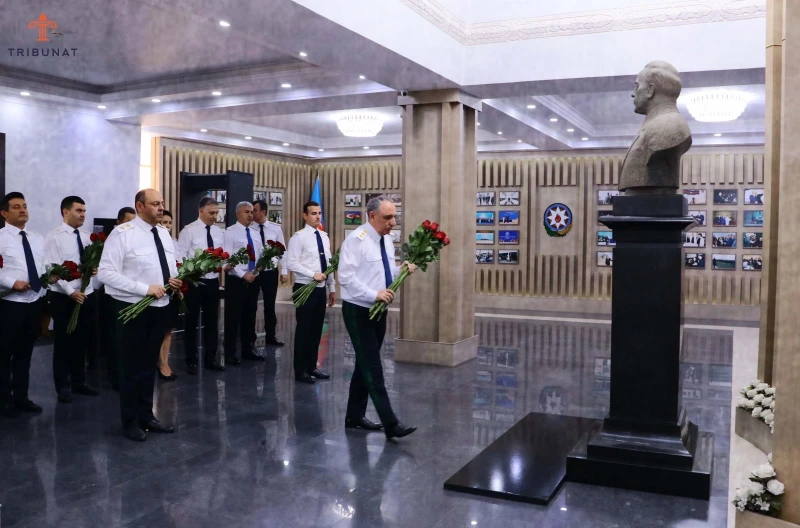
On July 24, a great board meeting was held at the Prosecutor General's Office to review the results of the tasks completed in the first half of this year and the works ahead. A significant part of the meeting was accompanied by praise for the authorities, and even at the end of the report, confidence was expressed that the prosecutor's office employees “will take a firm position in relation to all negative situations and elements posing threat to the interests and benefits of our people and state in the process of successfully continuing the state policy implemented under the leadership of the President of the Republic of Azerbaijan, Mr. Ilham Aliyev”.
“Tribunat” analyzed whether there was a violation of the constitutional principle of the separation of powers, and examined the legality of the speeches, against the background of the endless praise of the prosecutor's office, an institution within the judicial system to the head of the executive branch.
State power in Azerbaijan is organized on the principle of separation of powers, in accordance with the Constitution. This separation entails legislative, executive, and judicial powers (Article 7).
As mentioned above, the prosecutor's office is part of the judicial system (Law “On the Prosecutor's Office”, Article 2). Article 5 of the law lists objectivity, impartiality and political neutrality among the main principles of the prosecutor's office. Ilham Aliyev is a politician and the leader of the ruling New Azerbaijan Party, and the praise received is a violation of the principle of political neutrality.
Article 7 of the Law “On the Prosecutor's Office” states inadmissibility for any person, for any reason, to directly or indirectly influence the lawful activities of the prosecutor's office. The main activity of the board meeting of the Prosecutor General's Office is shown as the successful continuation of state policy implemented under the leadership of a politician.
Per “Code of Ethical Conduct for Prosecutors”, official statements of prosecutors in the media must be reliable and balanced, since they are considered the official position of the prosecutor's office, and discussions must be conducted without prejudice to legal norms (§24.2). Upon statements to the media, prosecutors must avoid statements and reactions that could lead to a conflict of interest, create the impression of political discrimination, or biased performance of official duties (§§24.3, 24.3.2).
The text analyzed is a press release from a board meeting held at the Prosecutor General's Office. Even though it was not directed to any journalist, it can be considered a statement circulated in the media since it was publicly released on behalf of the prosecutor's office.
Simultaneously, a prosecutor's office employee should not provide financial or any other support to political parties, and should not engage in campaigning, except in cases provided for by law (§7.2).
The UN “Guidelines on the Role of Prosecutors” indicate that prosecutors, like other citizens, may exercise their freedoms of expression, conscience, association and assembly. Nonetheless, in exercising these rights, they must always act in accordance with the law, accepted professional standards and ethics (§8).
The Rome Charter, prepared by the Consultative Council of European Prosecutors, states that prosecutors must perform their duties free from external pressure or interference, taking into account the principle of the separation of powers (§5). They must strive to be independent and impartial, refrain from political activities incompatible with the principle of impartiality, and not act in situations where their personal interests or relationships with persons interested in the case may interfere with their full impartiality (§6).
The Guide on Article 6 of ECHR affirm that Article 6 § 1 of the Convention requires that the judiciary be independent of the other branches of government, namely the executive and the legislature (§55).
The praises voiced at the board meeting held at the Prosecutor General's Office constitute a violation of a number of fundamental principles, such as the prosecutor's office not supporting political organizations in any way, not engaging in political campaigning, and being impartial and objective. The prosecutor's office, as a body within the judicial branch, must be independent and impartial while exercising freedom of expression, must not show dependence on any other branch of government, and must not conduct political campaigning.
The principles of impartiality and political neutrality are also the key guarantees of the legitimacy of administration of justice.
“Tribunat” concludes that the admiring speeches of the Prosecutor General and prosecutor's office employees about the head of the other branch - the executive - of government and the politician, and the declaration that they will work to successfully continue the policy implemented under his leadership, contradict the principle of separation of powers enshrined in the Constitution, domestic legislation, the code of ethical conduct, and the requirements of a number of international documents.