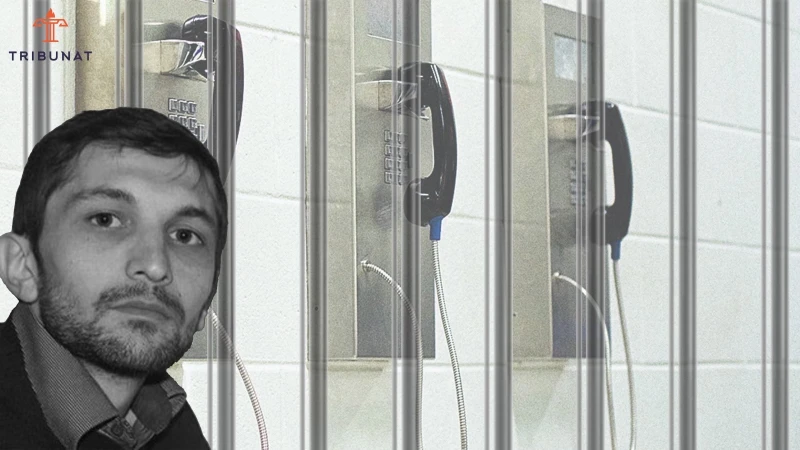
Polad Aslanov, a political prisoner at Penitentiary Institution No. 15, reports that he is compelled to make phone calls to his family from the institution's director’s office in his presence. His wife noted that “the head of the Penitentiary Institution said that now he will only call home from the offices of the head or deputy head. As soon as Polad starts talking about the poor conditions of detention, the connection is cut off.”
"Tribunat" analyzed the topic from the perspective of the right to inviolability of private life (“right to privacy”, used interchangeably – ed.).
The right to inviolability of private life is a constitutionally protected right (Article 32 of the Constitution). This right ensures the inadmissibility of interference by the State or third parties with an individual’s private and family life, correspondence, telephone conversations and other personal information. The European Court of Human Rights (ECtHR) stated in the Petrov v. Bulgaria case that telephone conversations, whether made from a person’s home or from prison, fall within the concepts of “private life” and “correspondence” within the meaning of Article 8 § 1.
According to Article 8 of the European Convention on Human Rights, to which Azerbaijan is a party, interference with the right to inviolability of private life is admissible by public authorities in such cases as are prescribed by law and are necessary in a democratic society in the interests of national security, public order or the economic well-being of the country, for the prevention of disorder or crime, for the protection of health or morals, or for the protection of the rights and freedoms of others.
ECtHR has held that such interferences violate Article 8 if they are (1) not “in accordance with the law”, (2) do not pursue one or more of the legitimate aims set out in paragraph 2, and (3) are “necessary in a democratic society” for objectives in question (Michaud v. France, § 93). An interference that does not meet any of these conditions constitutes a violation of the right to privacy.
In Silver and Others v. the United Kingdom, ECtHR indicated that the expression “in accordance with the law” requires, firstly, that the measure impugned must have a basis in domestic law; secondly, it refers to the quality of the law in question, that is, that it must be accessible to the person concerned and that its impact must be foreseeable.
In accordance with Article 84.5 of the Code of Execution of Sentences, surveillance of telephone conversations and video calls of prisoners is admissible only if it is necessary to ensure public order and security, compliance with regime requirements, prevention of new offenses and crimes, as well as protection of victims. Surveillance should be carried out by a reasoned decision. According to Article 24 of the European Prison Rules, prisoners should be provided with ample opportunities to communicate with family members and other persons, and restrictions should be applied only in exceptional cases and should allow for the continuation of contact, albeit at a minimum level. In addition, Creation of conditions that ensure the continuity of family relations is specifically stressed.
In the context of these standards, Polad Aslanov’s situation is particularly controversial. He was engaged as a journalist until his arrest. Even though he was arrested on charges of treason, a number of local and international human rights organizations have linked his arrest to his journalistic activities and, considering it politically motivated, have called on the Azerbaijani government to immediately release him. During his sentence, Aslanov periodically held hunger strikes to protest his illegal arrest, the failure to provide him or his lawyer Elchin Sadigov with the court decision, and the pressure on his lawyer. During these actions, he also demanded the release of other political prisoners. As a result, Aslanov was transferred from Penitentiary Institution No. 1, where he was serving his sentence, to Penitentiary Institution No. 15, which is known for harsher and more inhumane conditions.
None of the four main reasons specified in the Code of Execution of Sentences – namely public security, regime requirements, prevention of offences and protection of victims –are applicable in relation to Polad Aslanov. There are no public statements in this regard either from the institution where he is held, or from the Penitentiary Service in general, or from his family members and lawyer. The fact that he was allowed to make telephone calls from the office of the chief or deputy chief solely because of his active protest against the conditions of his detention and the violations of the law to which he was subjected, and the fact that the conversations were immediately cut off when he expressed his dissatisfaction, excludes the application of the norm of the Code referred to, which allows for surveillance of the prisoner’s telephone conversations.
Article 159 of the Internal Disciplinary Rules of Penitentiary Institutions (Internal Disciplinary Rules) provides for the surveillance of prisoners' telephone calls by the staff of the penitentiary institution. However, since no justification and specific conditions for the application of this article are provided, the surveillance procedure is arbitrary and vague. Accordingly, the said norm is not incompatible with the principle of “quality of law”.
The fact that Aslanov's telephone conversation was conducted only from the office of the head of the institution or his deputy and in their presence also violates the provisions of Article 160 of the Internal Disciplinary Rules. The said paragraph states that a special room with telephone booths is organized in the penitentiary institution for prisoners to conduct telephone conversations. The fact that Aslanov was forced to hold a conversation not from the booth installed in a special room, but from the office of the head of the Penitentiary Institution or his deputy, contradicts the requirements of the referred paragraph of the rules.
Permanent character of restrictions, systematically applied without any explanation to the prisoner, and interference with their content – that is, the topics discussed– denotes that this measure is not applied within the framework of a quality law.
“Tribunat” concludes that the restriction on telephone conversations imposed on Polad Aslanov does not comply with the objectives and grounds set out in the Code of Execution of Sentences, nor with the requirements of international law. These measures are neither justified nor implemented in a transparent manner, and moreover, their application constitutes an interference with the prisoner's right to privacy.