According to media reports, Kanan Zeynalov (also known by the nickname “Basqal” - ed.), the pro bono bodyguard of the chairman of the Popular Front Party of Azerbaijan (PFPA), Ali Karimli, has been kept in “isolation” for 7 months following his arrest. In words of the party chairman, “He (Kenan Zeynalov - ed.) has been kept in complete isolation for these 7 months. The regime does not keep terrorists who have committed serious crimes as incommunicado as Kanan. For 7 months, Kanan has not been given the opportunity to meet with his family, or even talk on the phone. Kanan said in court that he came to court wearing the clothes he was wearing when he was arrested 7 months ago. Because he has not been given a change of clothes to change into. This is the extent of the prejudice”.
Kanan Zeynalov was detained on March 21 of this year. He is accused of stabbing a 36-year-old man in the abdomen in the Yeni Gunashli settlement of Baku's Surakhani district. Kanan Basgal denies the charges and has mentioned his framing. Zeynalov is charged under Article 126.2.4 of the Criminal Code (generally dangerous method, with hooliganism intent). Zeynalov's case is currently being considered by the Baku Grave Crimes Court, that is, he should be considered as accused.
“Tribunat” has analyzed the legality of the restrictions on Kanan Zeynalov.
For this purpose, the article will analyze the restrictions imposed on Zeynalov thematically.
Domestic and international penitentiary legislation recognizes the rights of accused held in pre-trial detention centers and guarantees their material security. According to Article 15 of the Law “On Ensuring the Rights and Freedoms of Persons Detained”, accused enjoy the right to meet with their defense counsel and legal representative, to receive parcels, gifts and packages, to use their own clothes and footwear, and to be provided with clothing appropriate to the climate in case of lack of suitable clothing. According to Article 19 of the Law, a detained person has the right to meet with close relatives or other persons whose contact is of legitimate interest four times a month for up to 4 hours in decent conditions and under supervision. Detainees have the right to talk on the telephone twice a week for up to 15 minutes. According to Article 21, if an accused is provided with clothing, such clothing must be in keeping with human dignity and must be different from that provided to persons serving sentences of deprivation of liberty.
According to the Internal Disciplinary Rules of the Pre-trial Detention Centers, a detainee has the right to meet with close relatives or other persons with whom he or she has a legitimate interest in maintaining contact, four times a month, for a period of up to 4 hours, in appropriate conditions and under supervision. If an objection is raised to the provision of a meeting, the reasons for the objection are noted in the application of the detainee or the individual visiting. In the event of epidemiological and serious infectious diseases, natural disasters and other emergency situations that prevent the normal functioning of the pre-trial detention center, the meetings are temporarily suspended. Detainees have the right to talk on the phone for up to 15 minutes twice a week. The right of a person to use the phone may be limited for a certain period of time by a reasoned decision of the body conducting the criminal proceedings or the administration of the pre-trial detention center in order to prevent planned crimes, ensure criminal prosecution and the safety of individuals, if necessary to ensure the regime in the pre-trial detention center. In accordance with the rules, detainee entering the pre-trial detention center undergo a medical examination and comprehensive sanitary cleaning in accordance with the current sanitary and epidemiological standards, and in case of absence of suitable clothes, as well as special clothes related to their official activities, they are changed and provided with attire suitable for the climate. Such clothing must be in compliance with human dignity and must be different from that provided to persons serving sentences of deprivation of liberty. In addition, detainees are permitted to bring and receive clothing in packages and bundles.
Similar norms are also provided for in regional and international penitentiary instruments. Via Article 24 of the European Prison Rules, prisoners shall be allowed to communicate with their families, other individuals and representatives of outside organizations by post, telephone or other means of communication on a reasonable basis, and to have such persons visit them. Contact and visits may be restricted or supervised where necessary for the continuation of criminal proceedings, the maintenance of public order and safety, the prevention of crime and the protection of victims of crime. Nonethless, such restrictions shall be limited to a minimum level of contact, including special restrictions imposed by the court. The administration of penitentiary institutions shall assist prisoners in maintaining adequate contact with the outside world. According to Article 20 of the Rules, prisoners who do not have appropriate clothing shall be provided with clothing suitable for the climate. This clothing shall not be humiliating or degrading. All clothing shall be kept in good condition and shall be changed when necessary.
According to Principle 19 of the United Nations Body of Principles for the Protection of All Persons under Any Form of Detention or Imprisonment, a detainee or arrested shall have the right to be visited and corresponded with, in particular, family members, and shall be given adequate opportunities to communicate with the outside world, subject to reasonable conditions and limitations established by law or regulations. By Principle 15, a detainee or arrested shall not be denied access to the outside world, in particular to his family or legal counsel, subject to exceptions, for more than a few days.
Under Rule 58 of the Standard International Minimum Rules for the Treatment of Prisoners (Nelson Mandela Rules), prisoners shall be permitted, under appropriate supervision, to maintain regular contact with their families and friends, and to correspond and meet with them by telecommunications, electronic, digital and other means, where possible in writing. Under Rule 19, every prisoner who is not allowed to wear his own clothes shall be provided with clothing suitable for the climate and adequate to protect his health. Such clothing shall in no case be degrading. All clothing shall be kept clean and in good condition. Undergarments shall be changed and laundered as frequently as necessary to maintain hygiene. In exceptional circumstances, when a prisoner is taken outside the prison for a permitted purpose, he shall be permitted to wear his own clothes or other inconspicuous clothing. According to Rule 20, if prisoners are permitted to wear their own clothes, measures shall be taken to ensure that they are clean and fit for use when they are admitted to the prison.
Since “Tribunat” has comprehensively covered the problem of telephone conversations and meetings with relatives and lawyers of arrested on the example of various cases, there is no need to repeat the analysis of this problem; political prisoners in particular regularly encounter this problem in penitentiary institutions, and it can be alleged that it is symptomatic. A noteworthy point here concerns K. Zeynalov's clothes.
Domestic legislation recognizes the provision of appropriate clothing to detainees for hygienic and sanitary purposes and the possibility of receiving clothing through parcels/bundles. According to Appendix No. 5 to the Resolution of the Cabinet of Ministers “On Approval of Food and Material Norms for Detainees or Arrested”, the following norms for the provision of clothing to detained persons held in pre-trial detention centers have been established:
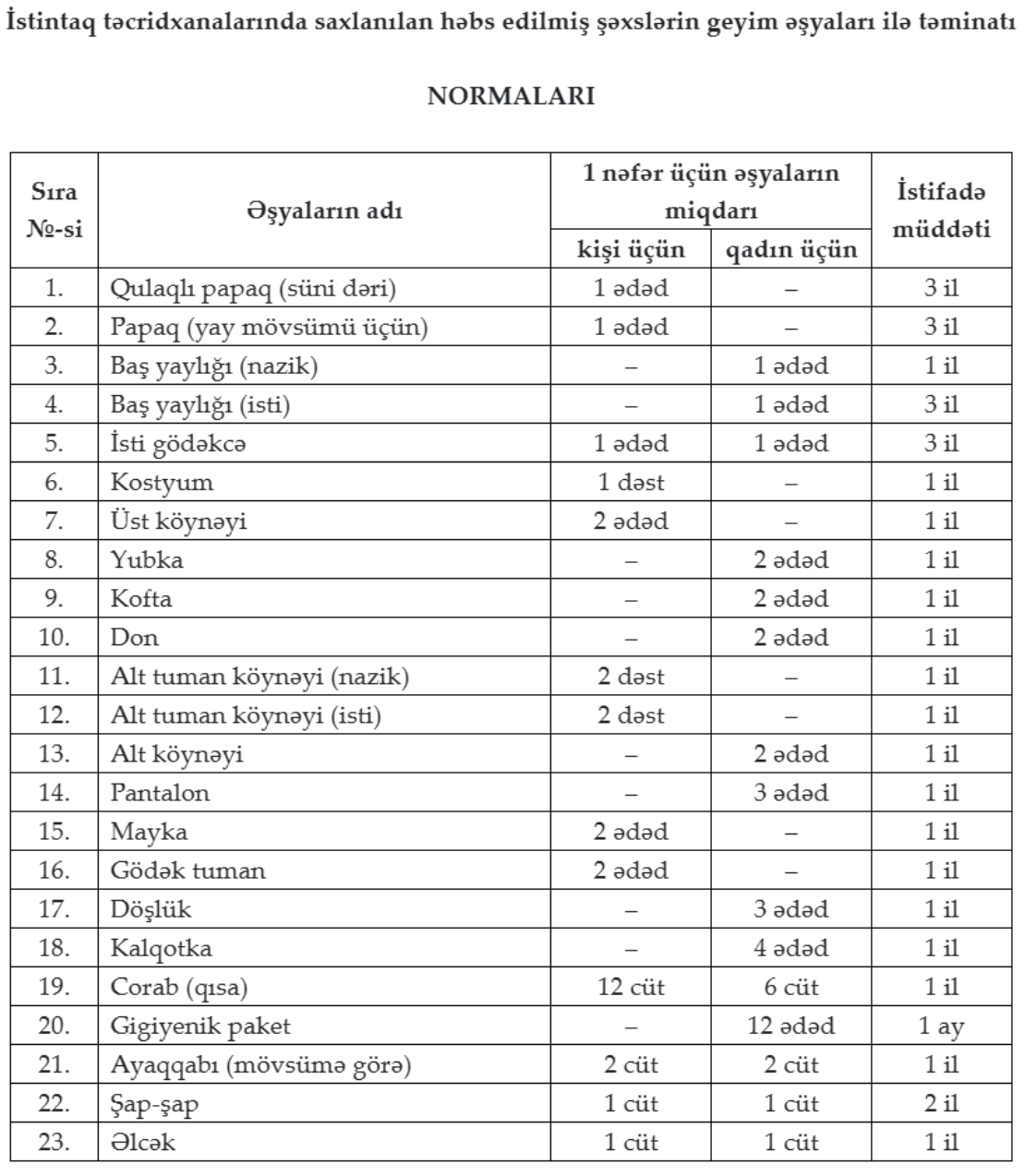
Seven months have passed since Zeynalov’s detention until the relevant news was published, which means that the two seasons have changed, spring and summer. During this period, the lack of provision of appropriate clothing and the creation of obstacles to its provision, taking into account the wear and tear of clothing, climatic conditions, and hygiene and sanitation issues, exposes him to humiliating treatment.
The problems of clothing provision for detainees are regularly covered in domestic media and relevant reports. For instance, according to the report of the Human Rights Commissioner (Ombudsman) on the National Preventive Mechanism against Torture for 2023, problems were identified with the provision of clothing items in penitentiary institutions and their hygienic and sanitary condition. Accordingly, in Penitentiary Institution No. 13, the National Preventive Group observed that clothes were worn out, in Penitentiary Institution No. 14, clothes were stored in the kitchen, and in the Penitentiary Service Treatment Facility, prisoners were not provided with clothing items.
Depriving an individual in a pre-trial detention facility of adequate clothing for months may amount to degrading treatment and a violation of his or her rights protected by domestic and international law; Article 3 of the European Convention on Human Rights (hereinafter, the ECHR) prohibits such treatment.
According to the case-law of the European Court of Human Rights (hereinafter referred to as the ECtHR), there is a strong link between the concepts of “degrading treatment” and “dignity” (Bouyid v. Belgium, §90). If treatment is degrading to an individual, shows contempt for his human dignity or arouses feelings of fear, suffering or is likely to break the moral and physical resistance of the individual, it can be characterised as degrading treatment and fall within the scope of the relations prohibited by Article 3 (Varga and Others v. Hungary, §70).
The ECtHR has concluded in several judgments, including in its judgments against Azerbaijan, that violations of basic sanitary and hygienic rules constitute a violation of the right not to be subjected to degrading treatment protected by Article 3 of the ECHR. In the cases of Ananyev and Others v. Russia, Longin v. Croatia; Insanov v. Azerbaijan; Aliyev v. Azerbaijan, the ECtHR recognized various issues that do not comply with sanitary and hygienic rules - poor ventilation of cells, lack of separation of toilet areas, and restrictions on the ability of detainees to use toilets and take showers - as violations of Article 3 of the Convention. It is obvious that the failure to provide Kanan Zeynalov with appropriate clothing in the pre-trial detention center where he was held for 7 months and the creation of obstacles to doing so are interpreted as degrading treatment and lead to a violation of his rights.
“Tribunat” concludes that the problems faced by the bodyguard of the chairman of the Popular Front Party of Azerbaijan (PFPA) Kanan Zeynalov in providing him with clothing amount to degrading treatment. Domestic and international legislation recognizes the right of persons detained in places of detention to be provided with clothing appropriate to the climate, sanitary and hygienic rules and wear and applies norms. The failure to provide Zeynalov with suitable clothing without giving any reason and the creation of obstacles to its provision violates his right not to be subjected to degrading treatment.