
The Decree “On the Establishment of an Electronic Court Information System” in 2014 was one of the first steps taken towards the digitalization of court services in Azerbaijan. The decree indicated “ensuring openness and efficiency, ... transparency in the administration of justice” as one of the goals of introducing the e-court information system. In 2020, the “Regulations on the Electronic Court Information System” was approved by presidential decree. The currently operating United Court Portal is under the supervision of the Judicial-Legal Council.
Since establishment, one of the characteristic features of the portal was the presentation of a brief biography, education, work experience and photo of the judges of all instance courts. Nevertheless, the updated portal only displays the judges' first name, last name, patronymic and the name of the court instance in which they are employed. For instance:
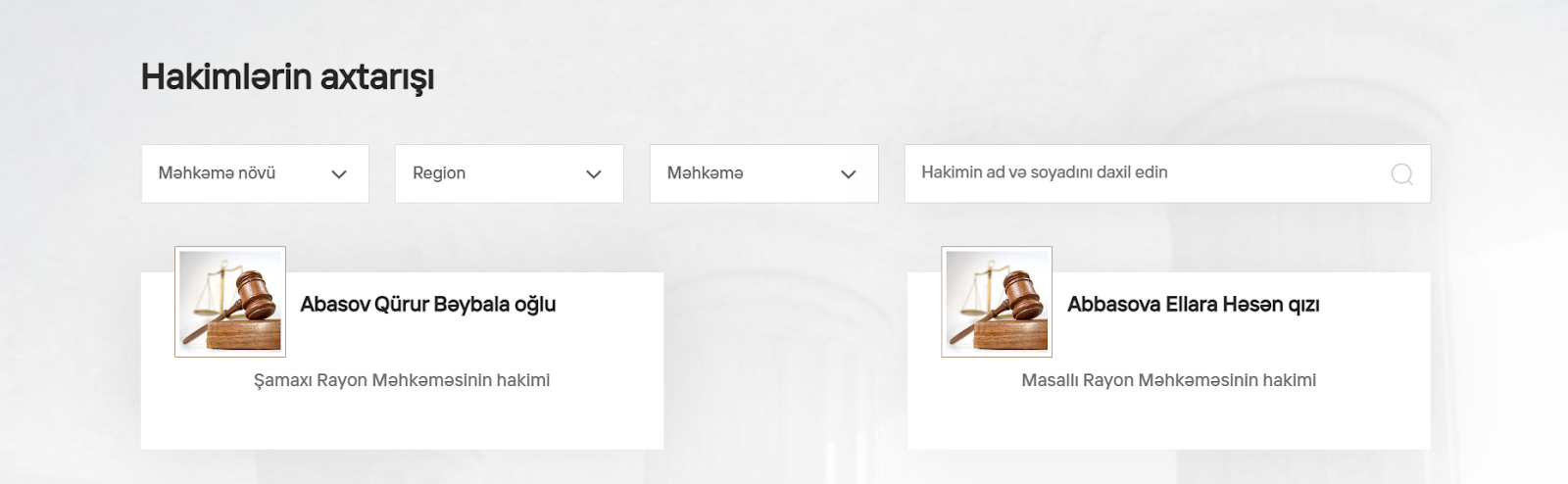
While it is currently feasible to obtain such information on the judges of the Supreme Court and the Constitutional Court on official internet resources, information on the judges of the courts of first and appellate instances is not available.
“Tribunat” investigated the impact of data accessibility about judges on the transparency of the judiciary.
The need to ensure the transparency of the judiciary stems from the functions performed by the court and judges. According to Article 125 of the Constitution, judicial proceedings must ensure the establishment of the truth. The Constitution and the Law “On Courts and Judges” set forth personal and professional requirements for the performance of judicial duties. In addition, according to Article 29 of the Law “On Access to Information”, judicial acts are considered information disclosure of which is mandatory.
The functions performed by courts and judges are public in nature. Article 127 of the Constitution establishes the principle of openness of judicial proceedings. Just as the effectiveness of the activities of other branches of government is characterized by ensuring openness, transparency and accountability, the judiciary must also adhere to these principles. Detailed information about courts and judges makes public supervision over activities possible.
The openness and transparency of the judiciary is directly related to the personal responsibility of judges. Article 92 of the Law “On Courts and Judges” defines the personal responsibility of each judge. The personal responsibility of judges is also one of the main elements of the Code of Ethical Conduct for Judges.
According to Article 9 of the Law “On Access to Information”, courts are considered owners of information and must fulfill the following obligations. Article 29 of the Law makes it mandatory to disclose “names, surnames, telephone numbers, e-mail addresses, as well as information about their education and qualifications” of officials of state bodies. The Law explains that the disclosure of such information is “for the purpose of ensuring the interests of society more easily and more promptly, and reducing the number of information requests”.
Although the “Regulations on the Electronic Court Information System” does not list information about judges among the information deemed necessary to be placed on the portal, Article 6 of the Regulations considers necessary to ensure the accuracy, completeness, relevance and reliability of the information for the functionality of the information system. Article 2 of the “Rules for the Formation, Maintenance, Integration and Archiving of State Information Resources and Systems”, which regulates the activities of such portals, declares transparency, i.e. “ensuring openness and accountability in the operation and provision of services of the state information resource and system”, as one of the pivotal principles for the formation of such databases.
Transparency and accountability of judicial proceedings and judges are also reflected in regional and international instruments. The 2010 Kyiv Recommendations on Judicial Independence by the OSCE Office for Democratic Institutions and Human Rights for Eastern Europe, the South Caucasus and Central Asia emphasize that professional accountability is viable through transparency. The recommendations provide that, as a rule, proceedings should be transparent, and that the court, its judges and its activities should be accessible to professional and public accountability (paragraph 32). The report on judicial councils of the United Nations Special Rapporteur on the Independence of Judges and Lawyers highlights the transparent and accountable functioning of judicial councils as an essential condition. Ensuring this is important for citizens’ trust in the judiciary, as well as for safeguarding against political influence and perception of self-interest (paragraph 59). Similar outlook on councils for the judiciary are shared in the Council of Europe Recommendations CM/Rec (2010) 12, entitled “Judges: independence, effectiveness and obligations”. Judiciary councils should demonstrate the highest level of transparency towards judges and the public through the procedures in place and reasoned decisions in their activities (paragraph 28). The Bangalore Principles on the conduct of judges also emphasize the significance of transparency and accountability of judges. According to the principles, a judge’s conduct should strengthen public confidence in the judiciary, and the judge should accept the constraints stemming from regular public scrutiny (paragraphs 3.2 and 4.2).
Judicial transparency and accountability have also been reflected in the case-law of the European Court of Human Rights. For instance, in Magyar Helsinki Bizottság v. Hungary, the Court highlighted the restriction of the public’s access to detailed information on appointments to public office as a violation of Article 10 (freedom of expression) of the European Convention on Human Rights. The Court also noted that the disclosure of information by Governments is necessary in the conduct of public affairs, matters of public interest and in ensuring public participation (§161).
One doesn't have to go far to explore good practices in the field of transparency. On the official internet resources of the courts of neighboring Georgia and Armenia, it is effortless to find photos, biographies and information about the work experience of judges of all instance courts. On the official internet resource of the courts of Estonia, it is possible to get a list not only of judges, but also of administrative staff, secretaries, translators, and human resources managers employed in the courts. For instance:

Information on judge of Lori Regional Court Varduhi Suruki Hovnayan (Armenia)
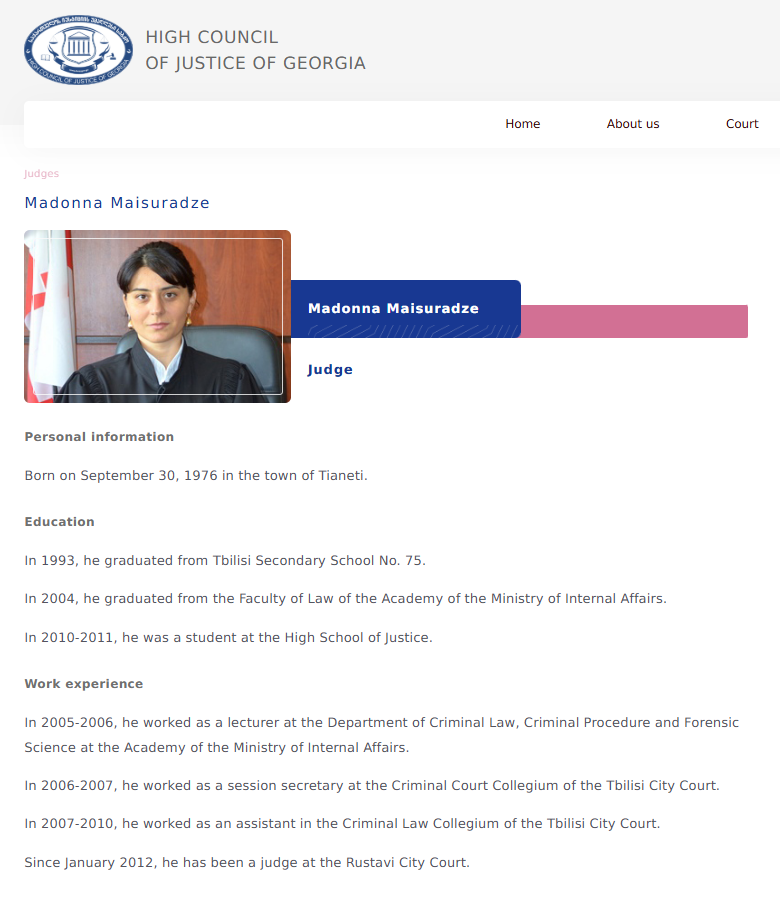
Information on judge of Rustavi City Court Madonna Maisuradze (Georgia)

The list of judges and administrative employees of Viru District Court (Estonia)
Judges exercise judicial authority to ensure administration of justice and the establishment of truth. The judiciary ensures that individuals holding this public office are open, transparent and accountable in terms of personal and professional qualities. The realization of these qualities creates trust in the judicial system and the establishment of justice among the general public through the responsibility and accountability of judges.
There is no official explanation or response as to the reasons for the removal of information about judges of first and appellate courts, unlike the previous version of the portal. The coverage of information about judges and their practice makes them more susceptible to public scrutiny and establishes deep responsibility and accountability for their activities. Since the launch of the portal, independent media organizations have occasionally published materials about procedural violations, political bias, and illegal entreprenural interests. This negative update on the portal may be aimed at minimizing the risks posed by transparency and accountability for judges. Nonetheless, these are just assumptions; by the time the analysis was published, an information request sent to the Judicial-Legal Council on the issue had remained unanswered, and the request had not been answered within the 7 working days as stipulated by law.
“Tribunat” concludes that the removal of biographical information about judges of first and appellate courts on the United Court Portal is contrary to local legislation, international recommendations and best practices. The lack of detailed information about judges undermines the quality of administration of justice, hinders public participation and scrutiny in public processes, and should be considered a significant setback in terms of the transparency of the judiciary.