Television Restrictions: Only ‘Khazar TV’ in Administrative Detention, Access Issues in New Penitentiary Complex
Analysis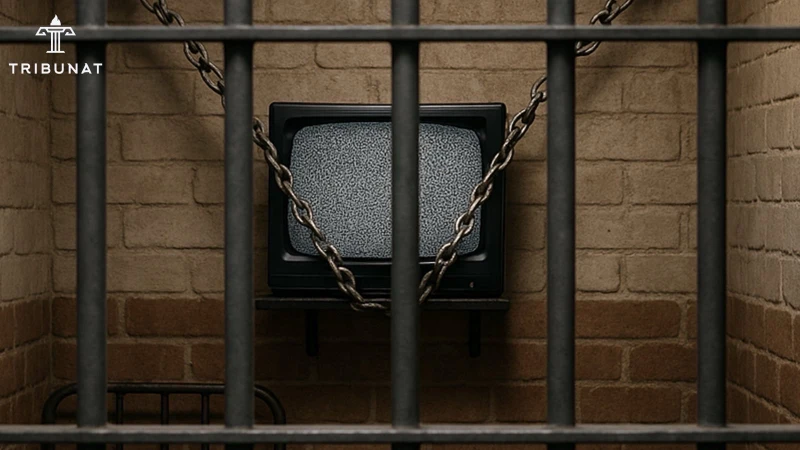
Afiaddin Mammadov, the chairman of the “Workers' Desk” Confederation of Trade Unions, sentenced to 8 years in prison for his activities as a human rights defender, notes that the right to information of detainees and prisoners in the Administrative Detention Center of the Ministry of Internal Affairs (MIA), pre-trial detention center and prison under the Penitentiary Service is restricted.
He mentioned that, it is not allowed to watch the state channel “AZTV”, “Ictimai TV” (Public Television – red.) and other channels in the Administrative Detention Center, the duty department of the institution decides both the channel to be watched and the time slot. The only allowed channel is “Khazar TV”. When asked to change the broadcast, they answer “all prisoners want to watch “Khazar TV”.
“In Baku Pre-Trial Detention Center No. 1, prisoners can pay 10 manats per month in order to connect to the “ATV+” network and watch foreign channels. However, this opening is not available in Umbaki Penitentiary Complex No. 3. Television is not provided at all in the closed-regime section of the complex. In the pre-trial detention center section, along with local channels, Iranian and Georgian channels, which lack broadcasting rights in Azerbaijan are shown through antennas. It is unclear why these channels are being watched by prisoners.”
“Tribunat” analyzed the facts within the framework of freedom of expression, based on the words of the detained human rights defender.
According to Article 50 of the Constitution, everyone is free to legally seek, receive, impart, produce, and disseminate any information.
The Law “On Ensuring the Rights and Freedoms of Persons in Places of Detention” and the Internal Disciplinary Rules of Pre-trial Detention Centers regulate the right of detainees or arrested to watch television programs. According to paragraph 16.4 of the Rules, televisions controlled by a centralized switching device are installed in cells. Watching television programs is determined by the day's schedule till bedtime.
Chapter 13 of the Code of Execution of Sentences defines “Educational work with persons sentenced to imprisonment for a certain period of time and life imprisonment.” According to the Code, when educational work is carried out with persons sentenced to imprisonment for a certain period of time and life imprisonment, the media, including radio and television, and viewing of films, are used, and libraries are organized.
According to the Internal Disciplinary Rules of Penitentiary Institutions, if necessary, the period for watching television programs may be extended up to an hour with the permission of the administration.
As observable from these regulations, limitation of the right to watch television programs to just one channel is not provided for in either the rules or the Code.
As per Afiaddin Mammadov, prisoners lack access to newspapers and magazines, even though it is provided for in the cited laws and regulations.
Article 10 of the European Convention on Human Rights provides for the freedom to receive and share information and ideas without interference by public authorities and regardless of borders.
The European Committee for the Prevention of Torture (CPT) noted in its report on its periodic visit to Azerbaijan from 8 to 12 December 2008 that both prisoners and staff confirmed that the opportunity to watch television had significantly reduced tension in the institution. Nevertheless, many prisoners complained that they were only allowed to watch television for four hours a day, and the delegation concluded that the issue of increasing the time allowed for television viewing could be reconsidered. The report also found that watching television and reading books mitigated, to certain extent, the negative impact of poor material conditions.
The European Prison Rules also put forward that prisoners, except in individual cases where a court imposes a specific ban for a certain period of time, should have the opportunity to regularly receive information about public events by subscribing to periodicals and other publications or by reading newspapers, as well as by regularly receiving information from radio and television. However, if referred to the words of A. Mammadov, the fact that the rights of arrested persons and prisoners to receive information are interfered with by forcing them to watch only one channel without any reason or by not being allowed to use television at all, and their chances of obtaining newspapers and magazines are limited is observed.
Nonetheless, the official press release in November 2023 regarding the conditions created in the Umbaki Penitentiary Complex noted that a library equipped with necessary literature and a TV room were installed in order to effectively organize the prisoners' leisure time.
In this vein, the utterances of the imprisoned human rights defender, "Television is not provided at all in the closed-regime section of the complex," are striking.
A. Mammadov asserts that legislative changes in this area could be useful; he suggests initiatives such as providing prisoners with limited access to the Internet and ensuring the affordable sale of all newspapers and magazines. When these proposals are analyzed in the context of Article 10 of the European Convention on Human Rights, it is clear that the European Court of Human Rights has recognized these rights as freedom of expression and has adopted a number of leading decisions on this issue.
For instance, in Kalda v. Estonia, the ECtHR stated in its reasoning that Article 10 cannot be interpreted as imposing a general obligation to ensure that prisoners have access to the Internet or to specific websites. However, given that domestic law allowed prisoners limited access to the Internet, the restriction of access to other websites containing legal information constituted a violation with the applicant’s right to information.
Additionally, in Ahmet Yıldırım v. Turkey, the Court reiterated the importance of websites in the exercise of freedom of expression, stating that, by virtue of their accessibility and the ability to store and disseminate large amounts of information, websites make a significant contribution to improving public access to the agenda and, more generally, to the dissemination of information. Article 10 concerns not only the content of information but also the means of its transmission, since any restriction imposed affects the freedom to receive and share information.
“Tribunat” concludes that the right to receive information is a constitutional right of any individual and this right cannot be restricted by unlawful interference. Forcing detainees to watch only one television channel, not providing them with access to it at all in the closed-regime section of the penitentiary complex, and limiting their access to newspapers and magazines is contrary to both domestic legislation and the European Convention on Human Rights. Detainees and prisoners should be informed about public events by reading newspapers and magazines and watching television without unlawful restrictions.
Azərbaycan Respublikasının Konstitusiyası; https://e-qanun.az/framework/897
Cəzaların İcra Məcəlləsi; https://e-qanun.az/framework/46951#_edn110
İstintaq təcridxanalarının daxili intizam Qaydaları; https://e-qanun.az/framework/33805
Cəzaçəkmə Müəssisələrinin Daxili İntizam Qaydaları; https://e-qanun.az/version/4140
Avropa İnsan Hüquqları Konvensiyası; https://www.echr.coe.int/documents/d/echr/convention_aze
“Azərbaycanda məhbusların media və informasiya hüquqlarının pozulması - həbsxanadan məktub” https://jam-news.net/az/az%C9%99rbaycan-h%C9%99bsxanalarinda-m%C9%99hbuslarin-media-v%C9%99-informasiya-huquqlarinin-pozulmasi-h%C9%99bsxanadan-m%C9%99ktub/
İşgəncələrin Qarşısının Alınması üzrə Avropa Komitəsi (CPT) 2008-ci ilin 8-12 dekabr tarixlərində Azərbaycana növbəti səfəri ilə bağlı hesabatı; https://www.refworld.org/reference/countryrep/coecpt/2009/en/70991
Avropa Penitensiar Qaydaları; https://justice.gov.az/categories/103
Yeni istifadəyə verilmiş Umbakı penitensiar kompleks ictimaiyyətə təqdim olunub
Kalda Estoniyaya qarşı AİHM qərarı; https://hudoc.echr.coe.int/eng#%7B%22itemid%22:[%22001-179032%22]%7D
Ahmet Yıldırım Türkiyəyə qarşı AİHM qərarı; https://hudoc.echr.coe.int/eng#%7B%22languageisocode%22:[%22AZE%22],%22appno%22:[%223111/10%22],%22itemid%22:[%22001-128097%22]%7D