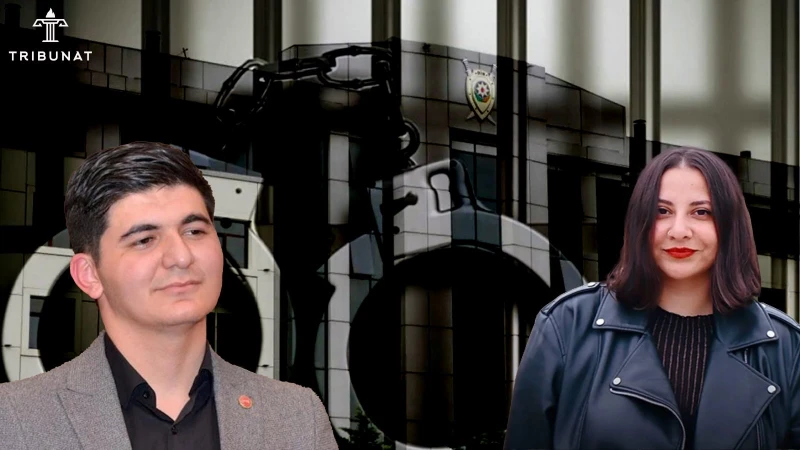
On May 6, journalist Ulviyya Ali (Guliyeva) was detained as an accused in relation to Meydan TV case. On the same day, the founder of Yoldash Media, Ahmad Mammadli, was detained with charges of intentional infliction of grievous bodily harm and hooliganism.
Both individuals were placed into custody as a preventive measure.
In a public letter addressed through her family, U. Ali voiced the violence she was subjected to by police officers. By her words, she was hit on the head by police officers because of the refusal to give the password to her mobile phone. Apart from bodily violence, the police officers threatened to rape her.
Ahmad Mammadli claims that he was subjected to police violence to sign the documents and give the password for the devices he was using. In a letter to his friends, the imprisoned Talysh researcher Igbal Abilov noted that he had seen Mammadli in the corridor of the detention center in recent days with his face and eyes swollen. A. Mammadli's wife uttered that during a meeting with her family, the activist said that his asthma worsened in the detention center, he had difficulty breathing, and that he has blurry vision due to the struck eyes.
“Tribunat” analyzed the right to be free from ill-treatment based on the facts regarding the two media representatives mentioned.
The Constitution of the Republic of Azerbaijan (Article 46, paragraph III) and the European Convention on Human Rights, to which State is a party (Article 3), declare that no one shall be subjected to torture or to inhuman or degrading treatment or punishment. The right not to be subjected to ill-treatment is an absolute right, that is, it cannot be subject to interference on the basis of any exception (European Convention on Human Rights, Article 15).
According to the Court’s case-law, ill-treatment must reach a minimum threshold of severity to fall within the scope of Article 3. The assessment of this threshold is relative and depends on all the characteristics of the case, such as the duration of the treatment, its physical or mental effects and, in some cases, the sex, age or state of health of the victim.
In order to ensure the right of individuals not to be subjected to ill-treatment, the European Court of Human Rights (hereinafter referred to as the “Court” or “European Court”) has established two main directions in its case-law (Guidelines on Article 3 of the European Convention on Human Rights).
In cases where the forms of treatment prohibited under Article 3 are intentionally committed by State authorities, the State has a negative obligation to refrain from causing serious harm to individuals within its jurisdiction. That is, State authorities, mainly police officers and representatives of law enforcement authorities, such as prosecutors, must abstain from ill-treatment of citizens.
Nevertheless, cases of ill-treatment of detainees in Azerbaijan are frequently reported.
The European Court also establishes positive obligations on States: (1) to establish a legislative and regulatory framework for protection; (2) to take operational measures to protect specific individuals from the risk of treatment contrary to this article in well-defined cases; and (3) to conduct an effective investigation into allegations of such treatment.
At large, the first two of these positive obligations are classified as “substantive”, while the third is classified as a “procedural” obligation of the State. Substantive positive obligations are the ones imposing to take preventive measures and create a legislative environment to protect individuals from torture, inhuman or degrading treatment. In other words, the State must establish a system to prevent such ill-treatment. Procedural obligations are the State’s obligation to investigate, in an effective, impartial and expeditious manner, any allegations of ill-treatment (torture, violence, etc.) that have already occurred.
Though domestic legislation prohibits torture and ill-treatment, Azerbaijan is failing to satisfy both its substantive and procedural obligations. The mere classification of these acts in the Criminal Code, in line with international standards, is not sufficient.
The European Court has highlighted the weak implementation of the legal framework in cases of torture in practice in a number of judgments against Azerbaijan (see Ibrahimov and Mammadov v. Azerbaijan, §§ 90-98). The lack of or ineffective video surveillance systems in pre-trial detention centres and police stations is an obstacle to prevent ill-treatment. Immediate access to lawyers is not guaranteed in practice – detainees are sometimes left without a lawyer for hours or even days. There is low confidence in the independence of the national preventive mechanism - Ombudsman’s Office, which calls into question its ability to conduct effective monitoring. Accountability to state officials or law enforcement agencies is lenient and the like.
Officials have not yet commented on the reports of physical violence against Ulviyya Ali and Ahmad Mammadli. U. Ali's mother, Ilhama Guliyeva, said in an interview with Toplum TV that the journalist's examination is being deliberately delayed so that the traces of injuries disappear. The journalist also stated in her letter that she was receiving treatment for benign tumors in brain, and relatedly, numerous documents related to examinations and treatment, as well as a disk of the operation, were seized by police officers. Despite this, the examination is being postponed.
It can be understood from the statements of the family members of the accused media representatives that the prosecutor's office's investigation into the allegations of ill-treatment has not yet launched. Despite the fact that almost 20 days have passed since the journalists' arrest, the fact that the investigation has not yet been begun begs the question of the standard of investigation into allegations of ill-treatment. The peculiarity of the investigation into physical violence is that it is carried out as quickly and efficiently as possible. However, the suspicious hesitance in starting the investigation, the disappearance of possible signs of injury on the victims' bodies day by day and others indicate a serious violation of the standard of investigation from the day one, before it even began.
“Tribunat” concludes that the allegations of police violence against journalists Ulviyya Ali and Ahmad Mammadli during their detention are not just a violation of their right to freedom from ill-treatment – they are another example of the systematic violation of human rights in Azerbaijan. The European Court has so far found violations of Article 3 of the Convention in 34 judgments against Azerbaijan.
According to the legal framework established by the European Court, the State must not only refrain from ill-treatment, but also have a responsibility to prevent such cases and, if they occur, to conduct prompt, impartial and transparent investigations. Azerbaijan is not only failing to fulfill its substantive positive obligations, but also its procedural obligations - allegations of torture, inhuman and degrading treatment are not subject to an independent, prompt and efficient investigation, accompanied by public scrutiny and the participation of the victim, and is not subject to adequate and effective investigation.